


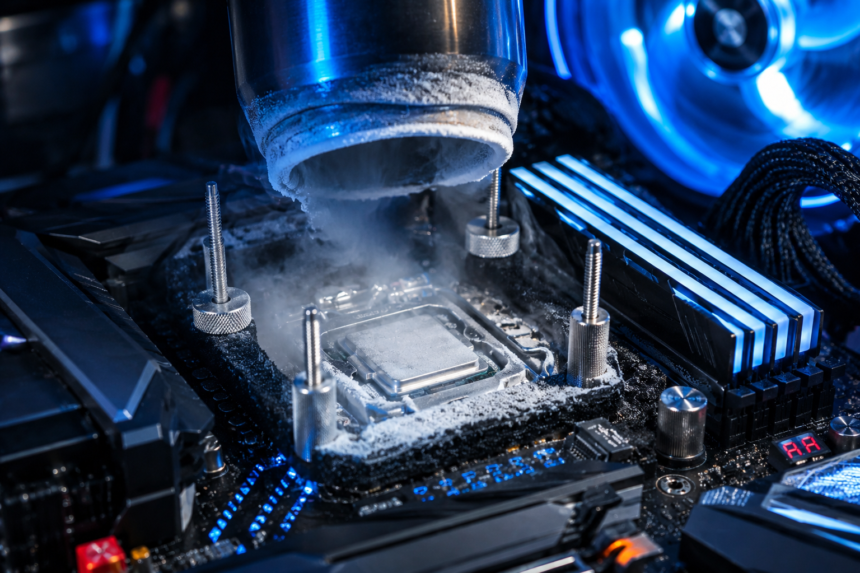
The Intel Core i9-14900KF has just achieved something that once sounded impossible. In a jaw-dropping overclocking experiment, the processor crossed the 9.2GHz barrier and officially became the fastest-clocked CPU ever recorded.
- Intel Core i9-14900KF Reaches 9.2GHz
- How the Record Was Achieved – Intel Core i9-14900KF
- Why Liquid Helium Was Necessary – Intel Core i9-14900KF
- What Makes the Intel Core i9-14900KF Special – Intel Core i9-14900KF
- Only a Few CPUs Have Crossed 9GHz – Intel Core i9-14900KF
- Why This Record Matters – Intel Core i9-14900KF
- This Is Not a Speed for Everyday Users – Intel Core i9-14900KF
- Can CPUs Reach 10GHz Next? – Intel Core i9-14900KF
- The Growing Popularity of Extreme Overclocking – Intel Core i9-14900KF
- Final Thoughts – Intel Core i9-14900KF
For years, CPU makers have competed to push processors faster and further. Gamers, PC enthusiasts, and overclockers have followed these battles closely. However, this latest achievement takes things to a completely different level.
The new record was achieved by Chinese overclocker wytiwx, who pushed Intel’s flagship desktop chip to an unbelievable 9,206.34MHz. The result has already been verified through HWBOT, the well-known global platform for overclocking records.
While regular users will never run their computers at these speeds, the achievement still highlights how far modern CPU technology has evolved.
Intel Core i9-14900KF Reaches 9.2GHz
The headline achievement here is simple but historic.
The Intel Core i9-14900KF became the first processor ever to cross the 9.2GHz frequency mark in a verified CPU benchmark run.
That clock speed is far beyond what normal desktop processors can achieve in daily use.
To put this into perspective, Intel officially rates the chip with a maximum turbo frequency of 6GHz. The overclocking result pushed it more than 3GHz higher than its stock boost speed.
That massive leap required an extreme setup, advanced tuning, and cooling methods far beyond ordinary PC hardware.
Still, the successful run marks a major milestone in CPU overclocking history.
How the Record Was Achieved – Intel Core i9-14900KF
Breaking a world record like this does not happen with standard cooling or basic settings.
The overclocker used a carefully tuned high-end setup built specifically for extreme frequency testing.
The system included:
- Intel Core i9-14900KF
- ASUS ROG Maximus Z790 Apex motherboard
- 16GB DDR5 memory
- ASUS ROG Thor 1600W power supply
- Liquid helium cooling
The processor reportedly operated at around 1.348V to 1.387V during the attempt.
To make the run stable, several cores and threads were disabled. Reports noted that only seven cores and seven threads were active during the record attempt.
This approach helps reduce heat and power demands, making it easier to achieve higher clock speeds.
Why Liquid Helium Was Necessary – Intel Core i9-14900KF
One of the most fascinating parts of the achievement is the cooling method.
The CPU did not rely on air cooling or even traditional liquid cooling. Instead, the overclocker used liquid helium, one of the coldest cooling methods available.
At extremely high frequencies, processors generate enormous heat in a very short time. Without aggressive cooling, the chip would instantly become unstable or shut down.
Liquid helium allows temperatures to drop to incredibly low levels, helping the CPU survive under massive electrical stress.
This type of cooling is only used in competitive overclocking because it is expensive, difficult to manage, and completely impractical for normal users.
Still, it remains the best way to push hardware to its absolute limits.
What Makes the Intel Core i9-14900KF Special – Intel Core i9-14900KF
The Intel Core i9-14900KF is already one of the most powerful desktop processors available.
It belongs to Intel’s 14th Gen Raptor Lake Refresh lineup and comes packed with high-end specifications.
Key features include:
- 24 cores
- 32 threads
- 8 performance cores
- 16 efficiency cores
- Up to 6GHz turbo frequency
- 36MB Intel Smart Cache
- 32MB L2 cache
- 125W base power
- 253W maximum turbo power
The processor was designed for gamers, creators, and performance enthusiasts who demand top-tier speed.
Even without overclocking, the chip already sits among the fastest consumer CPUs ever released.
Only a Few CPUs Have Crossed 9GHz – Intel Core i9-14900KF
Crossing the 9GHz barrier is extremely rare in the world of CPU overclocking.
According to reports, only a handful of verified HWBOT submissions have managed to achieve it.
Before this new record, the previous milestone belonged to another Intel chip, the Core i9-14900KS, which reached around 9,117MHz.
For many years before Intel’s dominance, AMD held the spotlight in extreme frequency overclocking.
The famous AMD FX-8370 reached 8,722MHz back in 2014 and stayed near the top for years.
However, Intel’s Raptor Lake and Raptor Lake Refresh processors have now completely taken over the top rankings.
Why This Record Matters – Intel Core i9-14900KF
Some people may wonder why extreme overclocking records matter if regular users cannot actually use those speeds.
The answer is simple.
These experiments show the true limits of modern silicon technology.
When engineers and overclockers push processors beyond normal operating conditions, they reveal how advanced chip manufacturing has become. Every small improvement in architecture, voltage control, and thermal handling contributes to higher performance ceilings.
Achievements like this also create excitement in the PC hardware community.
For enthusiasts, breaking records is similar to motorsports. It is not always about practicality. Sometimes it is about seeing how far technology can go.
The Intel Core i9-14900KF record proves that modern CPUs still have incredible headroom when paired with extreme cooling and expert tuning.
This Is Not a Speed for Everyday Users – Intel Core i9-14900KF
It is important to understand one thing clearly.
The 9.2GHz result does not represent normal CPU performance.
No gaming PC or standard workstation can run continuously at those speeds.
The processor needed:
- Exotic cooling
- Heavy voltage tuning
- Disabled cores
- Specialized hardware
- Short benchmark sessions
For normal users, the Core i9-14900KF still operates much closer to its official rated frequencies.
Even so, the record highlights the incredible potential hidden inside Intel’s silicon.
Can CPUs Reach 10GHz Next? – Intel Core i9-14900KF
After seeing a processor hit over 9.2GHz, many enthusiasts are already asking the next big question.
Can CPUs eventually cross the 10GHz barrier?
Right now, experts believe that reaching 10GHz remains extremely difficult. Recent records have improved only by small margins each year.
Current Intel Raptor Lake chips may already be approaching their practical limits.
Future architectures such as Nova Lake could potentially push things further, but nobody knows exactly when a verified 10GHz result will happen.
Still, the overclocking community loves challenges, and history shows that impossible goals often become reality over time.
The Growing Popularity of Extreme Overclocking – Intel Core i9-14900KF
Extreme overclocking has become a serious hobby and competitive activity over the years.
Professional overclockers spend countless hours experimenting with:
- Voltage adjustments
- BIOS settings
- Cooling techniques
- Motherboard tuning
- Memory optimization
Platforms like HWBOT track global rankings and allow enthusiasts to compete for world records.
Manufacturers also pay close attention to these achievements because they demonstrate the quality of their hardware.
That is one reason premium motherboards like the ASUS ROG Maximus Z790 Apex are specifically designed for overclocking enthusiasts.
Final Thoughts – Intel Core i9-14900KF
The Intel Core i9-14900KF has officially secured its place in CPU history by reaching a record-breaking 9,206.34MHz frequency.
While this incredible speed required liquid helium cooling and an extreme custom setup, the achievement still showcases the remarkable progress of modern processor technology.
For gamers and everyday users, this record may not change daily computing directly. However, for the hardware world, it represents another huge milestone in the endless pursuit of performance.
More importantly, it proves that the race for faster processors is far from over.
As CPU technology continues to evolve, enthusiasts around the world will keep pushing hardware beyond expected limits, and someday, the dream of a 10GHz processor may finally become reality.
Read another interesting article here: 3D-MIND Device